
A featured contribution from Leadership Perspectives: a curated forum reserved for leaders nominated by our subscribers and vetted by the Construction Tech Review Advisory Board.

KRUK România
Robotic Process Automation (RPA) and Risk Management: A Strategic Perspective

Costin Buga
Costin Buga is an experienced leader in Project Management, Lean Management, and Digital Transformation, with a proven track record of driving operational excellence and business agility. With extensive experience in managing complex projects, he ensures seamless execution by optimizing workflows, aligning business objectives with execution strategies, and coordinating cross-functional teams to deliver measurable outcomes. His expertise in Lean Management enables organizations to streamline processes, eliminate inefficiencies, and implement continuous improvement methodologies that enhance productivity and long-term value. At the forefront of Digital Transformation, Costin leverages modern technologies and Low Code solutions to accelerate innovation, improve organizational efficiency, and drive scalable automation strategies that keep businesses competitive in an evolving digital landscape. Passionate about strategic execution and innovation, he is committed to helping organizations navigate transformation while ensuring sustainable business impact.
In today’s fast-evolving digital landscape, organizations are constantly seeking ways to optimize operations, reduce costs, and mitigate risks. One of the most effective tools in achieving these objectives is Robotic Process Automation (RPA) . With years of experience in digital transformation and process automation, I have observed firsthand how RPA reshapes risk management by enhancing efficiency, improving compliance, and reducing human error.
The Role of RPA in Risk Management
Risk management is a fundamental component of any business strategy, ensuring that organizations remain resilient in the face of operational, financial, or compliance-related risks. Traditional risk management relies on manual processes, which are prone to inefficiencies and human errors. This is where RPA brings significant value by automating repetitive, rule-based tasks, thereby increasing accuracy and reliability.
As the leader of the LowCode team within my company, responsible for implementing the Low Code strategy (RPA, Power Automate, AI, ML, etc.), I have seen firsthand how automation transforms risk management in three key ways:
1.Enhancing Compliance and Auditability
Regulatory compliance is a major challenge for organizations, especially in industries such as finance, healthcare, and manufacturing. RPA ensures that processes adhere to compliance requirements by maintaining detailed logs of every action performed. This not only simplifies audits but also provides a clear trail of accountability.
At KRUK, process automation complements our internal audit systems and strengthens our commitment to regulatory compliance and operational transparency.
2.Reducing Operational Risks
Manual processes introduce variability and potential errors that can lead to financial losses or reputational damage. By automating data entry, reconciliations, and validation processes, RPA minimizes inconsistencies and ensures operational continuity with minimal supervision.
Our software bots operate under the strictest cybersecurity and personal data protection standards, fully compliant with GDPR.
3.Strengthening Fraud Detection and Prevention
In an era where cyber threats and fraud schemes are increasingly sophisticated, RPA serves as a critical line of defense. Bots can monitor transactions in real-time, flag anomalies, and cross-check large datasets faster than any human workforce. When combined with AI and machine learning, RPA becomes even more powerful in predictive risk analysis.
At KRUK, we ensure that any decision directly affecting our clients' financial status is subject to human review, regardless of the level of process automation.
Automation supports risk detection but will never replace ethical judgment in matters impacting our customers.
RPA Adoption Across Industries
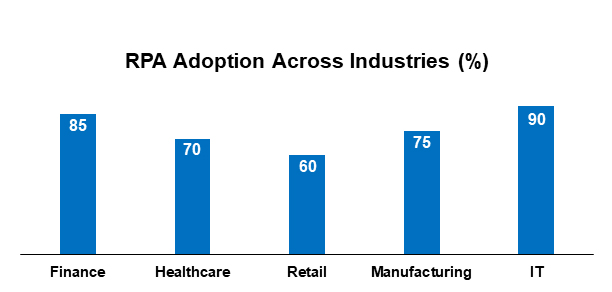
The adoption of RPA varies across industries, with sectors such as finance, healthcare, and IT leading the way due to their need for compliance, operational efficiency, and fraud prevention. The chart below illustrates how different industries are leveraging RPA to enhance their risk management strategies:
Source: 50 RPA Statistics from Surveys: Market, Adoption & Future
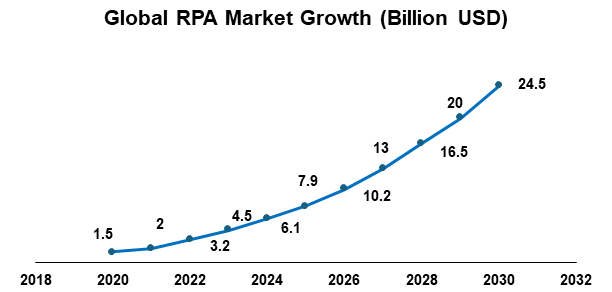
Market Growth of RPAWith increasing adoption, the global RPA market is experiencing exponential growth. The following chart presents the projected market expansion of RPA between 2020 and 2030, highlighting the increasing role of automation in risk management and business resilience:
Source: Robotic Process Automation Market Trends – Grand View Research
Key Benefits of RPA in Risk Management
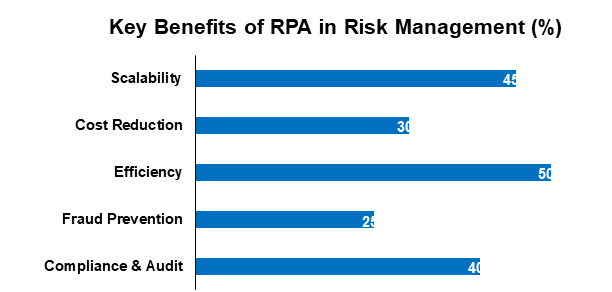
Organizations leveraging RPA in their risk management frameworks are experiencing substantial benefits. The following chart showcases the key advantages of RPA in risk mitigation, including compliance enhancement, fraud prevention, improved efficiency, cost reduction, and scalability:
Beyond operational efficiency, RPA at KRUK is designed to support our employees by automating repetitive tasks. This allows our teams to focus on strategic initiatives and client interactions where human judgment remains irreplaceable.
Source:
Challenges and Considerations
While RPA offers significant advantages, it is not a one-size-fits-all solution. Implementing automation in risk management requires a strategic approach. Based on my experience, some key considerations include:
• Scalability and Flexibility:
Not all risk management processes can or should be fully automated. Organizations must identify high-impact areas where automation delivers measurable benefits.
• Integration with Legacy Systems:
Many companies operate on outdated infrastructure that may not be fully compatible with RPA tools. Seamless integration requires careful planning and sometimes additional investment in middleware solutions.
• Governance and Oversight:
While bots reduce human error, they still require monitoring to ensure they function as intended. A governance framework should be in place to address exceptions and evolving regulatory requirements. We have defined backup scenarios and clear procedures for rapid intervention in case of any software bot malfunction, ensuring operational continuity and client service stability.
The Future of RPA in Risk Management
Looking ahead, I see RPA playing an even more integral role in risk management as technology advances. The convergence of RPA, AI, and advanced analytics will allow organizations to shift from reactive to proactive risk mitigation, identifying potential issues before they escalate.
Beyond the implementation of the LowCode strategy, the company is driving a Business Continuity Planning (BCP) initiative, where automation plays a critical role in ensuring operational resilience. By integrating RPA into BCP frameworks, organizations can rapidly respond to disruptions, automate recovery processes, and maintain business continuity with minimal downtime.
It is essential to highlight that, at KRUK, our automation journey is deeply rooted in ethical principles. Technology empowers us, but human oversight remains central to our decision-making process—especially when it comes to protecting the financial wellbeing of our clients.
From a leadership perspective, the key to unlocking the full potential of RPA in risk management lies in aligning automation strategies with business objectives, fostering a culture of continuous improvement, and ensuring cross-functional collaboration between IT, compliance, and operational teams.
As someone deeply involved in digital transformation, I firmly believe that RPA is not just a tool for cost-cutting—it is a strategic asset that, when implemented correctly, strengthens an organization’s resilience and competitive advantage. The businesses that embrace this shift will be better equipped to navigate uncertainties while driving operational excellence.

